As we close 2025, the California higher education landscape—our collective “Enrollment Kitchen”—is undergoing a transformation more radical than any seen since the 1960 Master Plan. Acting as the eyes and ears for the “Enrollment Chef,” I have conducted an exhaustive social listening and data analysis exercise spanning the last twelve months. I have monitored the pulse of the market from the marble halls of the State Capitol in Sacramento to the anxious threads of r/ApplyingToCollege and r/GradSchool.
The data reveals a system in paradox. On the surface, the “menu” has never been more accessible: The University of California (UC) system admitted a record 77% of California applicants in Fall 2025. The California State University (CSU) has launched revolutionary “Direct Admissions” pilots to remove friction for the working class. Yet, beneath this veneer of access lies a fragile infrastructure.
The “guests”—our students—are struggling to find seats at the table, not because of tuition, but because of a housing crisis that has turned into a retention crisis.
Simultaneously, the “kitchen staff”—our faculty and administrators—are bracing for a hostile takeover attempt by the “Trump 2.0” federal administration, whose proposed “Compact for Academic Excellence” threatens to strip billions in funding and dismantle the values of institutional autonomy.
This report serves as the comprehensive “mise en place” for the Enrollment Chef. It dissects ten critical trends that are shaping the ingredients (students), the kitchen (institutions), and the critics (employers/government). It concludes with a drafted blog post for the Enrollment Chef’s Kitchen, ready for publication, synthesizing these complexities into a palatable narrative for your readership.
Trend 1: The Federal-State Sovereignty Crisis (“The Compact”)
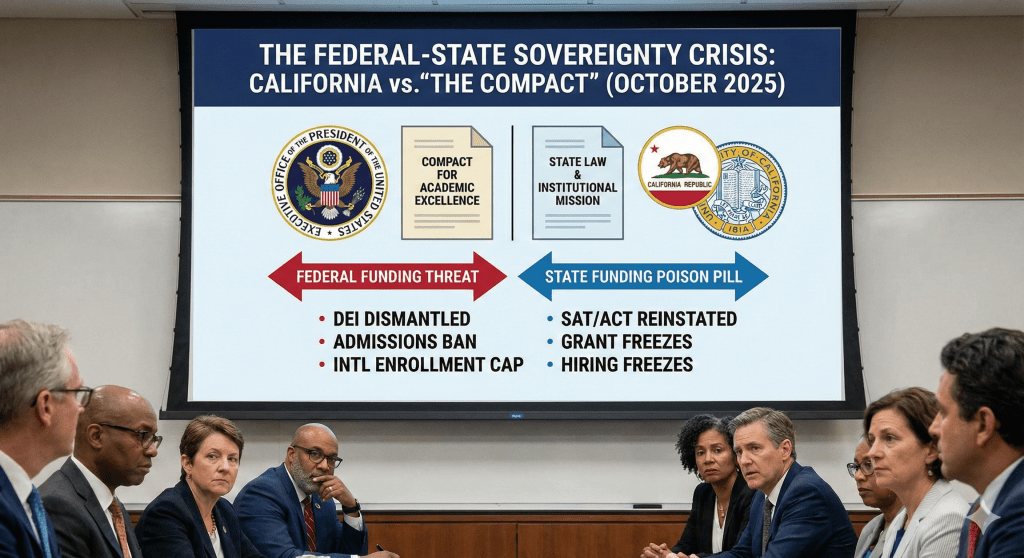
The most dominant signal in our 2025 listening data is the geopolitical collision between California’s higher education system and the federal executive branch. Following the inauguration of President Donald Trump in January 2025, the administration wasted little time in targeting what it viewed as the “adversarial academia” of the West Coast. This culminated in October 2025 with the issuance of the “Compact for Academic Excellence in Higher Education“.
This document is not merely a policy proposal; it is a structural ultimatum. The Compact offers preferential access to federal research grants, overhead payments, and administrative streamlined processing to universities that agree to a suite of ideological and operational conditions. Conversely, it implies—and in some cases explicitly threatens—the withdrawal of these life-sustaining funds for non-signatories. For California, a state that secures more federal research dollars than any other, this is an existential economic threat.
The specific terms of the Compact are engineered to dismantle the prevailing governance model of California’s public institutions. The Compact mandates the dismantling of Diversity, Equity, and Inclusion (DEI) offices. In California, where equity is a statutory goal of the Master Plan and deeply embedded in the “UC 2030” and “CSU Forward” strategic plans, compliance would require violating state mandates and institutional mission statements.
It demands a strict ban on race or gender consideration in admissions. While California’s Proposition 209 already bans affirmative action, the Compact goes further, targeting “proxy” metrics and holistic review processes designed to ensure diverse cohorts.
Perhaps most damaging to the financial model of the UC, the Compact proposes capping international student enrollment at 15%. For campuses like UC San Diego and UC Irvine, where international tuition cross-subsidizes domestic affordability and research, this is a direct attack on the balance sheet.
The Compact requires the reinstatement of SAT/ACT scores. This directly conflicts with the UC and CSU decision to go test-blind, creating a legal paradox where complying with the Feds means violating Board policy.
The reaction from California’s leadership has been uniform defiance, effectively creating a “Sanctuary Campus” dynamic. Governor Gavin Newsom has drawn a hard line, stating that any university signing the Compact would immediately forfeit state funding—a “poison pill” designed to prevent defections.
We observed this play out in real-time correspondence and public statements. The University of Southern California (USC), despite being a private institution and theoretically more autonomous, “respectfully declined” the Compact in October 2025. Interim President Beong-Soo Kim’s message to the Trojan community emphasized that while they would not sign, they remained open to “national conversation”—a diplomatic rejection aimed at preserving federal grants without capitulating to federal control. Similarly, Caltech and Stanford have engaged in quiet diplomacy, while the UC system has prepared for litigation.
The consequences of this standoff are already materializing. Social listening across academic Twitter and Reddit threads reveals widespread anxiety among Principal Investigators (PIs) and graduate students about grant freezes.
The Department of State has already moved to suspend 38 institutions from the “Diplomacy Lab” partnership, including likely California targets, signaling that the “soft power” of federal funding is being weaponized. Institutions like Caltech are explicitly discussing “buffers” using unrestricted endowment funds to bridge the gap if federal NIH or NSF grants are delayed or withheld. However, as noted by Caltech faculty leadership, “buffers have limited capacity”.
Overall, we are seeing immediate hiring freezes and a pullback on new capital commitments. The “Enrollment Kitchen” is being forced to cook with the lights dimmed, conserving energy for a potentially long winter of federal austerity.
Trend 2: The “Open Door” Paradox (Record Access vs. Yield Volatility)
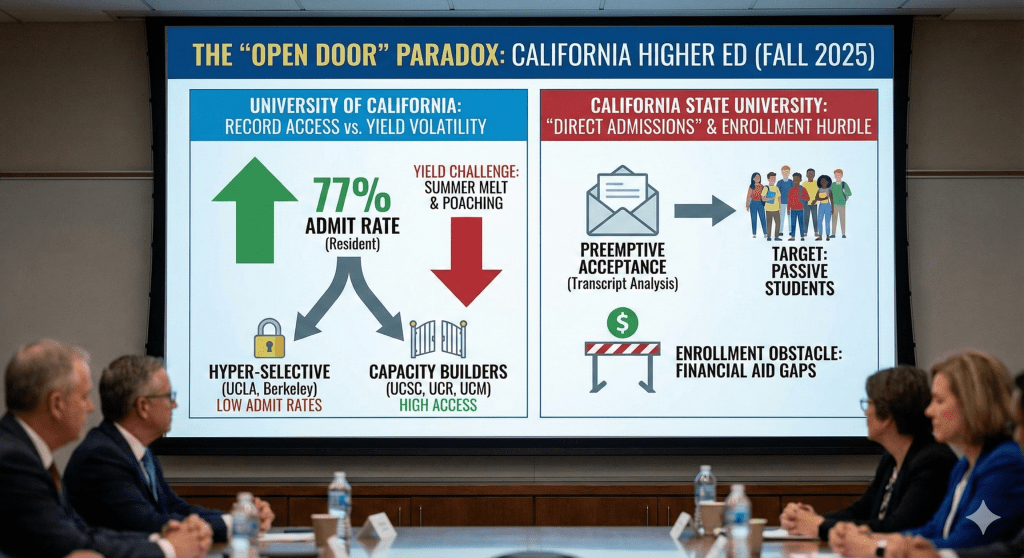
University of California: For decades, the narrative surrounding the University of California has been one of scarcity—a “closed door” that turned away thousands of qualified 4.0 GPA students. In 2025, that narrative was inverted. UC Institutional Research data analysis confirms that for the Fall 2025 cycle, the UC system admitted an astounding 77% of California resident applicants. This 7-point jump in acceptance rate is not a statistical anomaly; it is a policy outcome. It reflects the “Compact with the Governor” (the state version, not the federal one) which mandated capacity growth in exchange for budget stability.
While UCLA (9.4% admit rate) and UC Berkeley (11.4%) remain hyper-selective, the “access” is being delivered by UC Santa Cruz (accepting ~60%), UC Riverside, and UC Merced. These campuses are doing the heavy lifting of the Master Plan. The acceptance rate for California Community College (CCC) transfers also hit 77.1%, fulfilling the promise of the transfer pathway.
However, high acceptance rates have introduced a new volatility: Yield. Enrollment managers are reporting that students are applying to more colleges than ever before—an average of 6.1 institutions per student. This inflation of application volume means that “soft” admits are less likely to convert into “hard” enrollments.
I have observed significant “summer melt” where students accepted offers in May but failed to show up in August. This is driven by the financial reality of housing (discussed in Trend 3) and competitive merit aid offers from out-of-state public universities (like Arizona State or Oregon) that are aggressively poaching California talent.
Social listening on r/ApplyingToCollege reveals deep frustration with the waitlist process. At UC Berkeley, the waitlist for Fall 2025 was effectively closed by July, with zero movement, leaving thousands of students in limbo for months. This “waitlist management” strategy allows universities to protect their yield statistics but inflicts significant psychological stress on families.
California State University System: while the UC opens its doors, the CSU is removing the doorframe entirely. Facing soft enrollment post-pandemic, the CSU system launched a “Direct Admissions” program for Fall 2025. Instead of waiting for students to apply, the CSU analyzed high school transcripts to identify eligible seniors and preemptively mailed them acceptance letters. This strategy specifically targets the “passive” student—often first-generation or low-income, who assumes they aren’t “college material” or is daunted by the application fees and bureaucracy. While official census data is pending, anecdotal reports from CSU admissions officers suggest a surge in “interest” from this segment, though converting that interest to enrollment remains a challenge due to financial aid literacy gaps.
Trend 3: Housing as the “Invisible” Tuition Cap
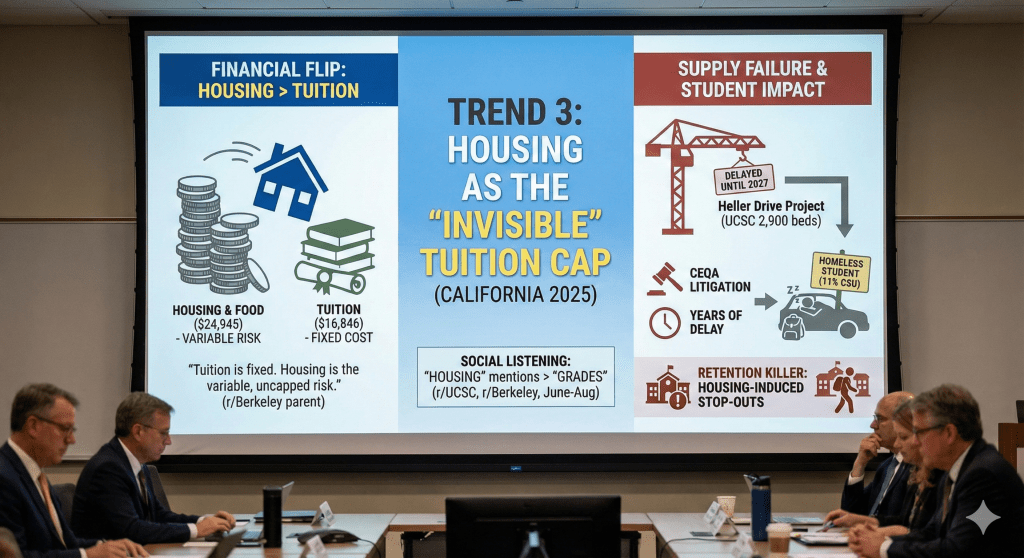
If there is one trend that dominates the negative sentiment in our social listening, it is housing. For the California student in 2025, tuition is a known fixed cost, often covered by aid. Housing is the variable, uncapped risk that threatens their education. On r/UCSC (UC Santa Cruz) and r/Berkeley, “housing” is mentioned more frequently than “grades” or “exams” in the months of June through August. Stories of students living in cars, sleeping in lounges, or commuting for 2+ hours are commonplace. A parent on Reddit noted that for a UC Berkeley freshman, housing and food ($24,945) now significantly exceed tuition ($16,846). This flips the traditional financial aid model, which was built to subsidize tuition, not market-rate rent in some of the most expensive real estate markets on Earth.
The “supply” side of the kitchen is broken. Universities are attempting to build their way out of the housing crisis, but they are thwarted by economic and legal headwinds. At UC Santa Cruz, the massive “Heller Drive” project, promised to deliver 2,900 beds, was delayed until at least 2027. The delay was communicated to students in July 2025—just weeks before the semester—causing chaos for student families who had counted on that capacity. Local community groups continue to use the California Environmental Quality Act (CEQA) to sue universities over enrollment growth, arguing that more students equal more traffic and noise. This litigation stalls projects for years, driving up costs and leaving students homeless. The housing crisis is a retention killer. Data indicates that 11% of CSU students experience homelessness. When a student cannot find a stable place to sleep, they cannot study. We are seeing a trend of “housing-induced stop-outs,” where students in good academic standing withdraw simply because they lost their lease. The “Enrollment Chef” must recognize that a bed is now a prerequisite ingredient for a degree.
Trend 4: The Graduate School Pivot and the Tech Exodus
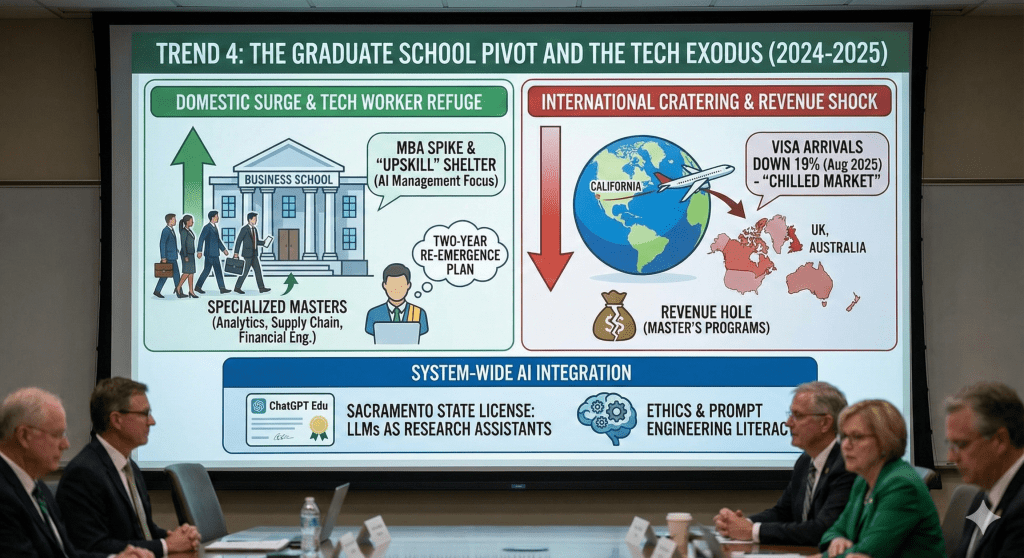
The California tech sector spent 2024 and 2025 “right-sizing,” a euphemism for shedding tens of thousands of jobs. Historically, when the job market cools, graduate school heats up. We are seeing this “counter-cyclical” trend manifest in specific ways. MBA applications for the 2024-2025 cycle spiked, particularly for full-time programs. Displaced tech workers are using the MBA as a two-year “shelter” to upskill and re-emerge when the market (hopefully) stabilizes. These aren’t students looking for generic management theory. They want “hard” skills. Demand is surging for specialized masters in “Business Analytics,” “Supply Chain Management,” and “Financial Engineering.” The “Tech MBA” at schools like UC Berkeley Haas and USC Marshall is evolving to focus less on “how to launch a startup” and more on “how to manage AI integration in a corporation”.
However, the graduate enrollment boom is purely domestic. International enrollment has cratered. Visa arrivals for students dropped 19% in August 2025. This is a massive hit. The Trump administration’s rhetoric and the explicit 15% cap proposed in the Compact have chilled the international market. Students from India and China, who historically flock to California for STEM graduate degrees, are pivoting to Canada, the UK, and Australia. It’s not a secret that Master’s programs often operate as revenue centers for universities. A 19% drop in international students is a revenue hole that cannot be easily filled by domestic students, who often require more financial aid.
Across all graduate disciplines—from the Humanities to Public Health—there is a trend toward integrating Artificial Intelligence. It is no longer a topic of Computer Science; it is a literacy requirement. Sacramento State launched a system-wide licensing of “ChatGPT Edu” for all faculty and students. This signals a shift from “banning AI” to “institutionalizing AI.” Graduate students are now expected to use LLMs as research assistants, and programs are scrambling to teach the ethics and prompt engineering required to do so effectively.
Trend 5: The “Adult Learner” Renaissance (The “Living Pantry”)
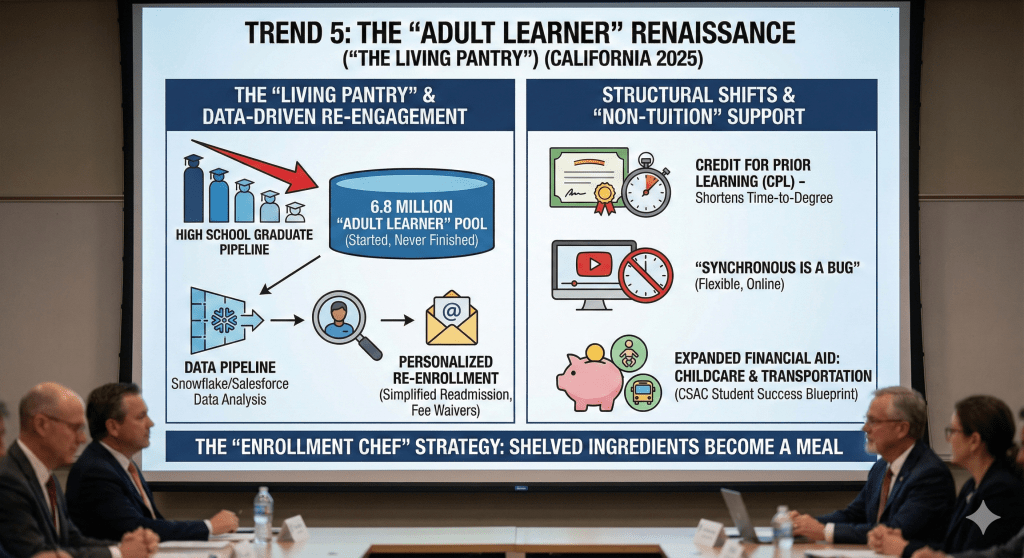
With the high school pipeline shrinking (the “Enrollment Cliff”), California institutions are turning their attention to the 6.8 million adults in the state who started college but never finished. This is the “Living Pantry” described in the Enrollment Chef blog—ingredients that were shelved but can be brought back to create a meal.
This is not just a marketing slogan; it is a structural shift in how enrollment is managed. CSU campuses are using data from platforms like Snowflake and Salesforce to identify students who left in good standing 3-5 years ago. They are reaching out with personalized “re-enrollment” offers that include simplified readmission forms and fee waivers. There is a system-wide push to standardize Credit for Prior Learning. If an adult has spent 10 years as a project manager, they shouldn’t have to take “Intro to Management.” Assessing and awarding credit for this experience is the single most effective tool for shortening their time-to-degree and reducing their cost.
For the adult learner, “synchronous” learning is a bug, not a feature. While undergraduate residential enrollment struggles, online degree completion programs are growing. The definition of “financial aid” is expanding to include childcare and transportation—the “non-tuition” barriers that stop adults from returning. The CSAC “Student Success Blueprint” explicitly targets these costs.
Trend 6: Workforce Alignment – The Healthcare & Climate Imperative
Healthcare
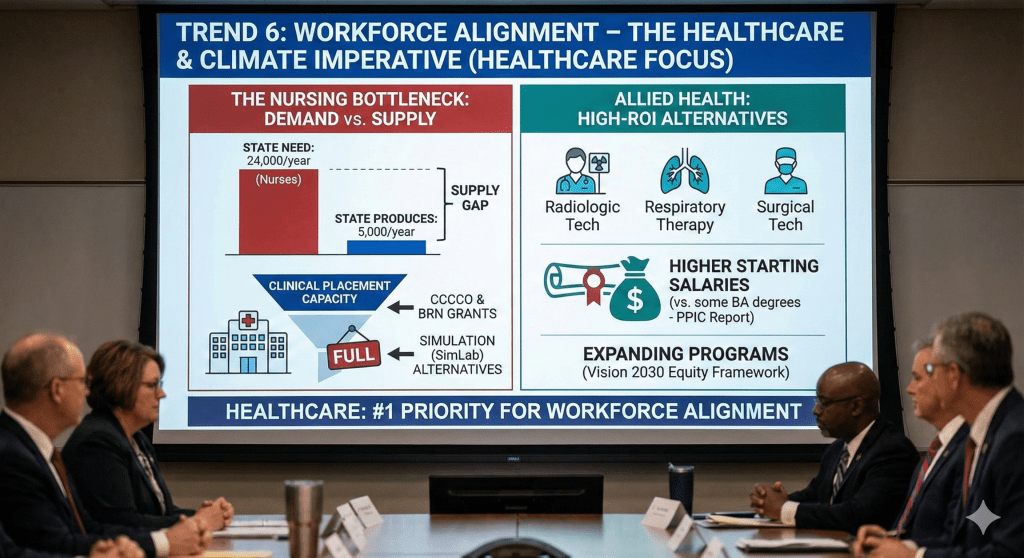
Healthcare remains the number one priority for workforce alignment. The state needs 24,000 new nurses a year, but produces only 5,000. Nursing is the #1 major for employment demand. The bottleneck is clinical placement capacity. Hospitals are too understaffed to supervise students. The CCCCO and the Board of Registered Nursing are deploying grants to incentivize clinical placements and are exploring simulation (SimLab) as a partial replacement for patient hours.
Students are increasingly looking at “Allied Health” careers—Radiologic Tech, Respiratory Therapy, Surgical Tech—as high-ROI alternatives to the impacted Nursing major. A report by the Public Policy Institute of California (PPIC) highlights that these Associate Degree programs often yield higher starting salaries than many Bachelor’s degrees in the humanities. Community colleges are expanding these high-cost, high-reward programs as part of the “Vision 2030” equity framework.
Climate Change as a Core Competency
California’s goal of Carbon Neutrality by 2045 has trickled down into the curriculum. UC San Diego now offers 25 graduate degrees related to climate change. It’s not just “Environmental Science” anymore; it’s “Climate Finance,” “Sustainable Urban Planning,” and “Resilient Engineering.” Gen Z applicants are demanding “climate justice” integration. They want to know how their degree will help solve the climate crisis. The University of California’s “Carbon Neutrality Initiative” (aiming for 2025 neutrality) is a major brand pillar used in recruitment.
Trend 7: The Financial ROI & The “Middle Class” Squeeze
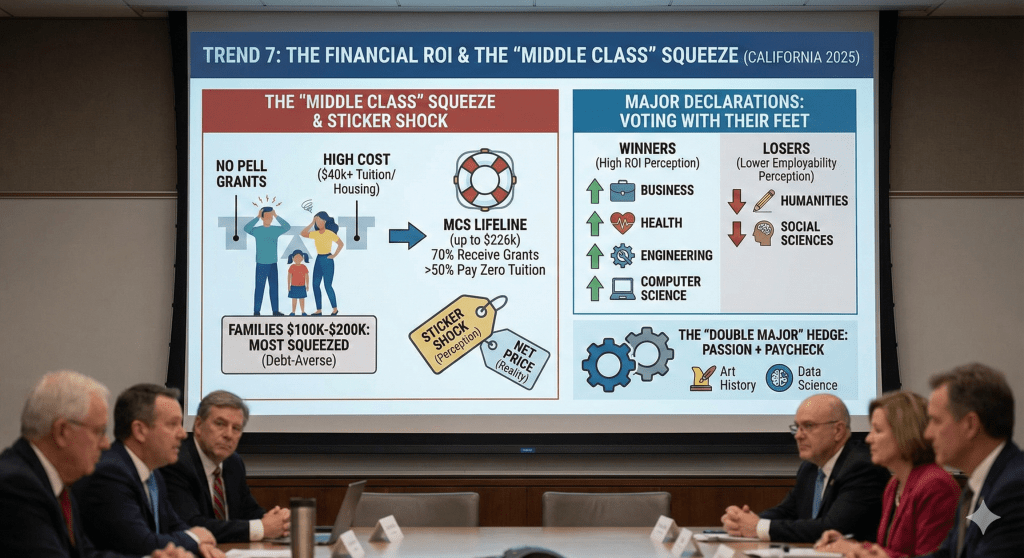
In 2025, the “Return on Investment” (ROI) conversation has moved from the kitchen table to the application portal. Families are price-sensitive and debt-averse. Families earning $100k-$200k are the most squeezed. They don’t get Pell Grants, but they can’t write a $40k check for UC tuition + housing. The “Middle Class Scholarship” (MCS) has been a lifeline, now covering families earning up to $226,000. The data shows that 70% of UC undergraduates now receive grants, and over half pay zero tuition. Despite this, the perception of high cost remains. “Sticker shock” deters applications. The Enrollment Chef must better communicate the “Net Price” vs. “Sticker Price.”
Students are voting with their major declarations.
- Winners: Business, Health, Engineering, and Computer Science are dominating.
- Losers: Humanities and pure Social Sciences are seeing enrollment declines as students perceive them as having lower immediate employability.38
- The “Double Major” Hedge: We are seeing a trend of students pairing a “passion” major (e.g., Art History) with a “paycheck” major (e.g., Data Science) to hedge their bets.
Trend 8: Social Sentiment – The Pulse of the Student Body
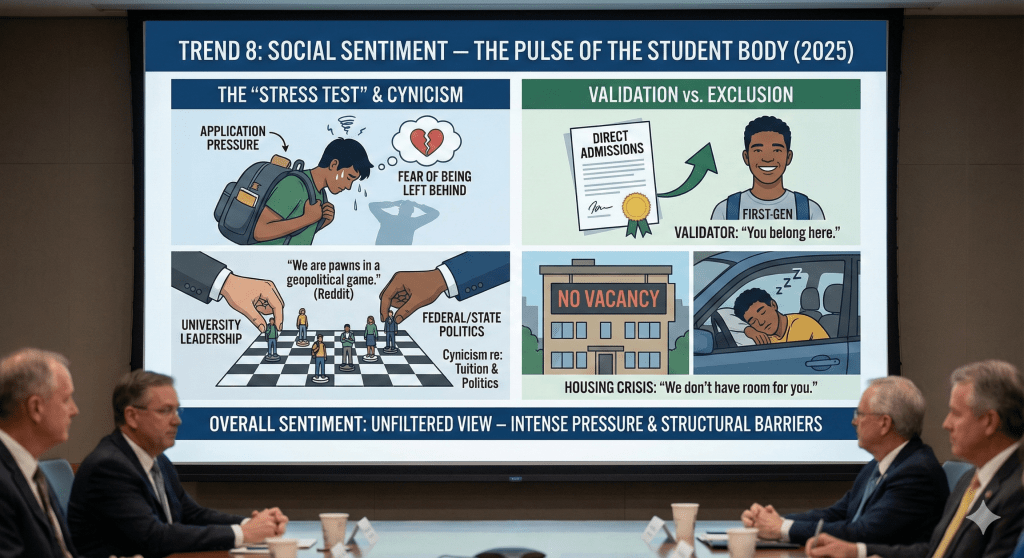
Social listening on platforms like Reddit provides a raw, unfiltered view of the student psyche. Students describe the college application process not as a journey of discovery, but as a “Stress Test”. They feel intense pressure to perform, driven by the fear of being left behind in a bifurcated economy. For first-generation students, the “Direct Admissions” letter is a powerful validator. It signals, “You belong here.” Conversely, the housing crisis signals, “We don’t have room for you.” There is a pervasive cynicism about university leadership, particularly regarding tuition hikes and the handling of the federal/state political fights. Students feel like pawns in a larger geopolitical game.
Trend 9: Institutional Resilience and Austerity
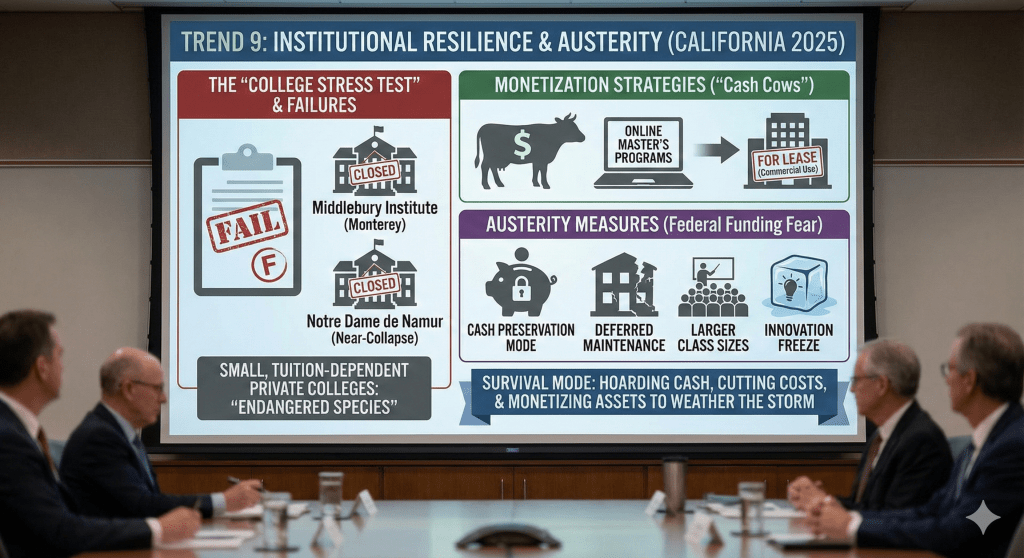
The “College Stress Test” isn’t just for students; institutions are failing it. The closure of the Middlebury Institute’s Monterey campus and the near-collapse of Notre Dame de Namur are cautionary tales. Small, tuition-dependent private colleges in California are on the endangered species list. To survive, institutions are trying to monetize everything. Campus real estate is being leased for commercial use. Online master’s programs are being launched as “cash cows” to subsidize the undergraduate mission. Universities are hoarding cash. The fear of federal funding cuts has led to a “cash preservation” mode. This means deferred maintenance on buildings, larger class sizes (to save on adjunct pay), and a freeze on innovative but risky new programs.
Trend 10: The Future of Transfer – The “Golden” Pathway
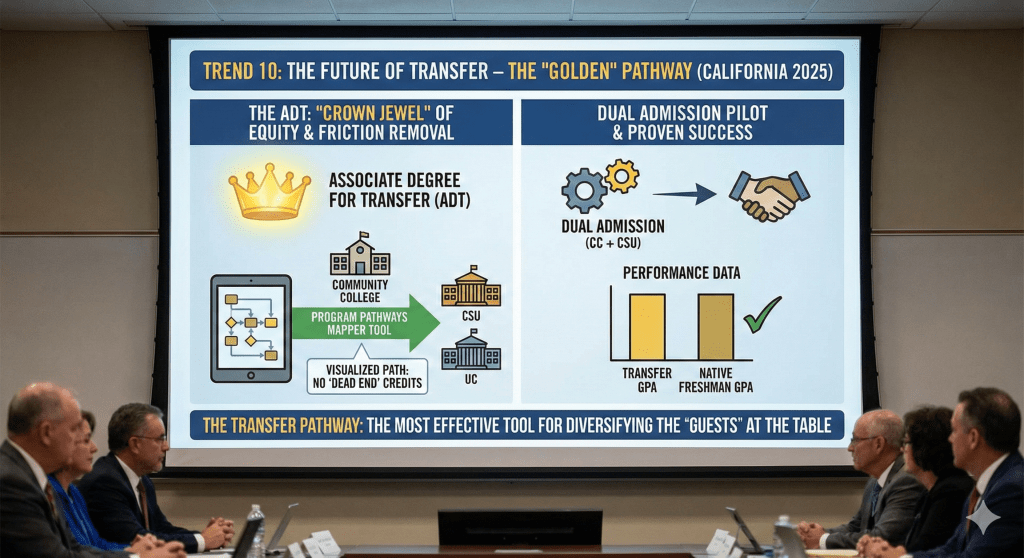
The Associate Degree for Transfer (ADT) is the crown jewel of California’s equity strategy. In 2025, the focus is on friction removal. Program Pathways Mapper software tool, now widely adopted, visualizes the path from community college to CSU/UC, ensuring students don’t take “dead end” credits. The pilot programs offering “Dual Admission”—where a student is admitted to a CSU while at a community college—are showing promise in keeping students on the path. Data shows that transfer students perform as well as, or better than, native freshman. The transfer pathway is the most effective tool for diversifying the “guests” at the table.
The year 2025 will be remembered as the year the “California Model” of higher education was tested by the opposing forces of expansive state access mandates and restrictive federal austerity. For the Enrollment Chef, the strategy must shift from “Gatekeeper” to “Guide.” The value proposition is no longer exclusivity; it is resilience. The winning institutions will be those that can shelter their students from the political storm while providing a direct, affordable path to the changing workforce.
The data is clear: The students are there. The demand is there. The challenge is strictly structural. It is time to remodel the kitchen.
 thestrategiccampus.blog