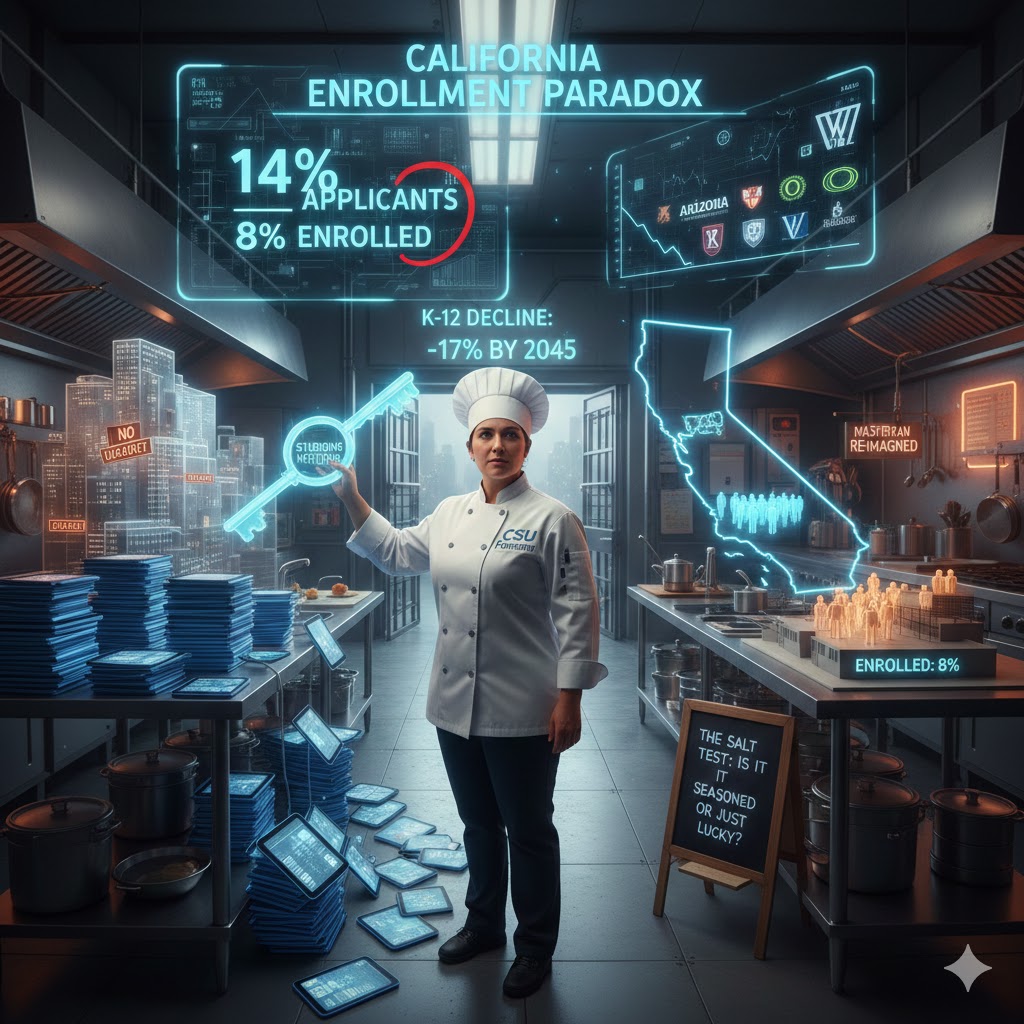
California’s higher education system is currently ensnared in a multifaceted statistical anomaly that threatens the state’s economic future. While the state serves as a primary engine for national academic demand, accounting for 2,016,955 applicants—approximately 14% of the 14,751,867 total applicants in the United States—its institutional capacity to absorb this talent is severely compromised. California enrolls only 149,678 students, representing a mere 8% share of the national total. This discrepancy is highlighted by a national enrollment probability of 0.1145 compared to a local probability for California at 0.0742.
This 4-percentage-point access gap leaves hundreds of thousands of individuals without a pathway to degree attainment within state borders. The selectivity crisis is further evidenced by California’s 47.45% admission rate, which sits 11.59 percentage points below the national average. Consequently, the state reported 1,059,985 rejections in the Fall 2024 cycle, the highest absolute number of “not admitted” students in the country.
Comparative Yield and Admission Metrics: Fall 2024
| Metric | National Total | California | Texas | Florida | New York |
| Total Applicants | 14,751,867 | 2,016,955 | 807,245 | 712,629 | 1,498,518 |
| Admitted and Enrolled | 1,688,725 | 149,678 | 129,383 | 73,801 | 124,306 |
| Admitted, Not Enrolled | 7,020,069 | 807,292 | 416,464 | 259,472 | 679,289 |
| Not Admitted | 6,043,073 | 1,059,985 | 261,398 | 379,356 | 694,923 |
| Admission Rate (%) | 59.04% | 47.45% | 67.62% | 46.77% | 53.62% |
| Yield Rate (%) | 19.39% | 15.64% | 23.70% | 22.14% | 15.47% |
The structural legacy of the 1960 Master Plan for Higher Education, which tiered access for the University of California and the California State University, has become a mechanism for exclusion. By 2015, high school students completing “A-G” requirements rose to 43%, creating a surplus of eligible students that exceeds the systems’ statutorily defined capacity. This has resulted in a “selectivity surge” where flagship campuses like UCLA and UC Berkeley report admit rates as low as 10% and 12%, respectively. Furthermore, the “yield gap” remains a critical bottleneck; California reports 807,292 students who were admitted but did not enroll, a figure more than five times the number of those who did matriculate. Much of this friction is attributed to the housing crisis, as ten UC campuses reported housing waitlists totaling over 13,000 students in Fall 2024. For these students, housing expenses constitute 43% of the cost of attendance at a UC and 57% at a CSU. Off-campus rent in university metropolitan areas rose by more than 30% between 2018 and 2022, effectively pricing out low-income families.
The Housing Crisis: Waitlists and Capacity at Selected Campuses
| Campus | Total Available Beds | Fall 2024 Waitlist | Housing Occupancy Rate (%) |
| UCLA | 24,202 | 2,303 | — |
| UC San Diego | 22,070 | 2,468 | — |
| UC Santa Cruz | 8,888 | 2,291 | — |
| Cal State Fullerton | 2,198 | 502 | — |
| Cal State Northridge | — | 2,000 | — |
| CSU East Bay | — | 0 | 58% |
| Sonoma State | — | 0 | 64% |
This capacity crisis has triggered a massive “export” of California’s intellectual capital. The number of students leaving the state for college has nearly quadrupled over twenty years, with a net loss of 24,000 students annually as of 2022. The Western Undergraduate Exchange (WUE) facilitated this outward migration for over 50,000 students in 2023-24, saving them an average of $12,517 per year in out-of-state tuition. California remains a massive net exporter in this exchange, sending out 17,584 students while receiving only 987 in return. Additionally, the 2024 FAFSA rollout saw California completion rates plummet by 19% by the May 2 deadline, representing a loss of nearly 60,000 applications. This disproportionately impacted Latino/a and Black students, who reported difficulty with the form at rates of 47% and 36%, respectively.
Impact of 2024 FAFSA Delays by Demographic
| Student Demographic | Percentage Reporting FAFSA Difficulty | Impact on Ability to Stay Enrolled (%) |
| Latino/a Students | 47% | 31% |
| Black Students | 36% | 36% |
| First-Generation Students | 43% | 29% |
| White Students | 30% | 21% |
| National Average | 40% | 25% |
The long-term economic implications are stark. California faces a “degree gap” of 1.1 million college-educated workers by 2030, as economic demand requires 40% of jobs to be held by bachelor’s degree holders while current attainment projections sit at only 33%. While the California Community College (CCC) system serves as a safety valve, growing by 9.6% to 2.1 million students in 2023-24 and accounting for 37% of total national community college gains, the transfer bottleneck remains. Only 40% of CCC students successfully transfer within six years. Compounding this is a “demographic cliff” where K-12 enrollment has declined for eight consecutive years, with a projected 15% drop of 600,000 students over the next decade. To achieve the Governor’s 70% attainment goal, the state must navigate these shrinking coastal pipelines and the 17% projected decline in high school graduates by 2045.
Long-Term Pipeline: Projected Change in High School Graduates (by 2045)
| State | Projected Change (%) |
| Florida | +7% |
| Texas | +1% |
| Georgia | 0% |
| United States | -5% |
| California | -17% |
| New York | -18% |
 thestrategiccampus.blog